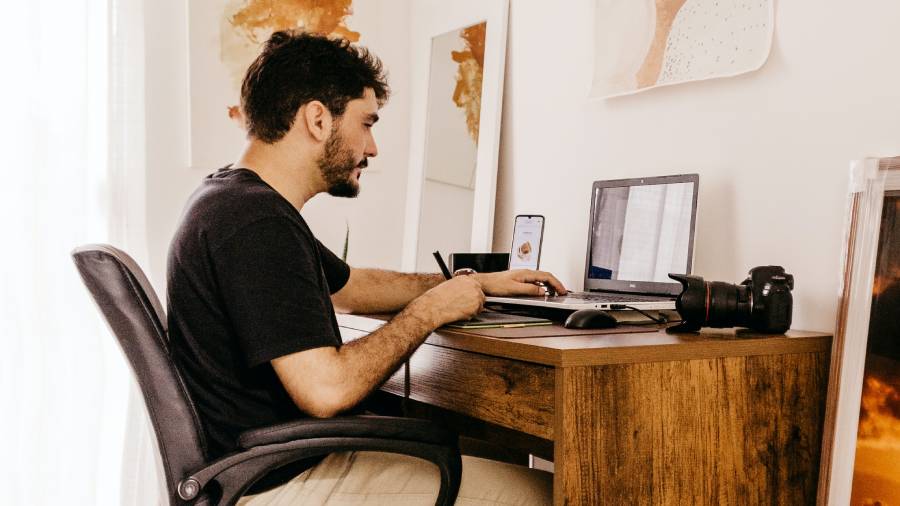
New research investigates the impact that working from home is having on employees, both mentally and physically and what more employers can do to help.
Research conducted by Fellowes Brands, a healthy workplace solutions provider, shows that working from home is taking a significant toll on employees’ health, both mentally and physically.
When surveyed, over a third of UK employees (35 per cent) admitted that they felt stressed or anxious when working remotely from home. A similar amount (32 per cent) felt lonely and isolated. Almost four in 10 (38 per cent) felt they were lacking in energy as a result of remote working.
The research also found that under half of those surveyed (49 per cent) have a proper work set-up. This has been attributed to the lack of legislation surrounding this issue, with employers only legally being responsible to provide workstation risk assessments if employees are ‘permanent’ home workers.

As a result, 49 per cent of employees who work remotely suffer from more physical strain working from home, with over a quarter suffering strained eyes (27 per cent), stiff neck (27 per cent), a sore or aching back (26 per cent), and headaches (25 per cent).
In addition to this, almost two-thirds of employees (65 per cent) were forced to spend their own money on home working equipment, spending £1300 on average.
As a result of this, a fifth of employees (19 per cent) felt that their employer does not care about their mental wellbeing and instead prioritises productivity, results and making money.
In addition, the vast majority of employees (58 per cent) confessed that they do not fully understand what their rights are when it comes to having a safe and healthy home working environment. A further six in 10 believe that home working should be regulated by the Government.
There is also a significant risk of burnout as over a third (35 per cent) feel they need to be available at all times throughout the day. Over 1 in 4 (29 per cent) say their employer rarely or never encourages them to take time away from their desk when working from home.
Despite all of this, nine in 10 employees (89 per cent) did state that they were keen to continue working from home but wished that they had a better work-setup (63 per cent), allowing them to feel more motivated and productive.
Just three in 10 (29 per cent) senior-level decision makers are considering the introduction of specific guidelines or regulations around home working, welfare or equipment provision. Just over a quarter (28 per cent) stated they will be making a conscious effort to increase focus on employee health and wellbeing.
Jeremy Cooper, UK Marketing Manager, Workplace Health Division at Fellowes Brands UK says:
It is essential that employers identify both the physical and emotional needs of their staff. We need to go beyond the office and embrace a work environment that is adaptable and supportive for all ways of working.
The online survey was funded by Fellowes Brands and commissioned by Atomik Research among 1,000 UK office workers who have been working from home for at least 4 months due to Coronavirus. The research fieldwork took place on 10 – 14 November 2020.

Monica Sharma is an English Literature graduate from the University of Warwick. As Editor for HRreview, her particular interests in HR include issues concerning diversity, employment law and wellbeing in the workplace. Alongside this, she has written for student publications in both England and Canada. Monica has also presented her academic work concerning the relationship between legal systems, sexual harassment and racism at a university conference at the University of Western Ontario, Canada.
- Monica Sharma

- Monica Sharma
- Monica Sharma
- Monica Sharma