

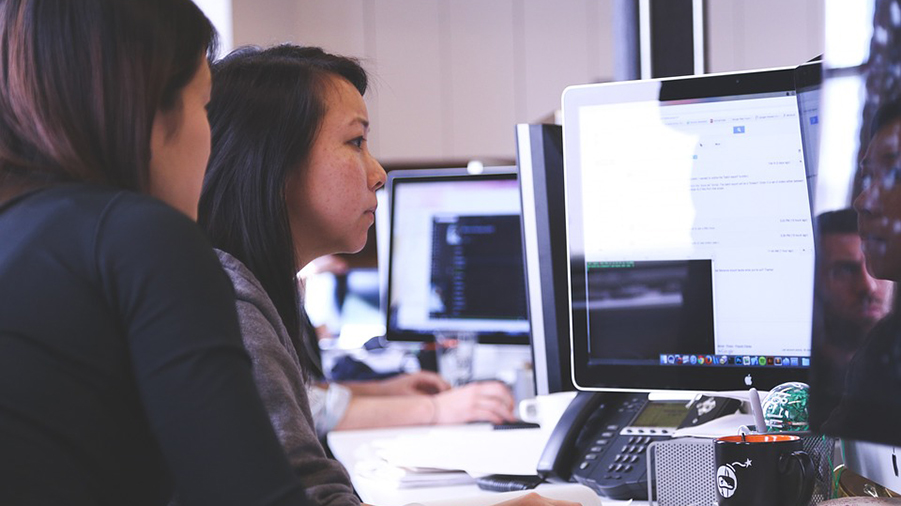

More than a fifth of businesses worldwide are spying on their employees. HRreview decided to reach out to professionals in the legal and analytics field to get their opinion on monitoring employees’ digital activity within the workplace.
Research by Gartner, a global research and advisory firm for businesses, revealed that 22 per cent of organisations around the world are using employee-movement data.
Additionally, just under a fifth of businesses (17 per cent) are monitoring statistics on how employees use their work computers and 16 per cent are utilising data on Outlook and digital calendar usage.

Gartner stated that this was significant as privacy is a “growing concern for individuals, organisations and governments.”
However, in July 2019, research conducted by Gurucul, a security and fraud analytics technology provider, found that 62 per cent of IT professionals would not be deterred from taking a job from a company that actively uses user activity monitoring.
Saryu Nayyar, CEO of Gurucul, said:
Workplace monitoring is often viewed as a spying tactic, used by paranoid or nosy employers to keep an eye on staff behaviour. But it depends on the type of monitoring being utilised.
Monitoring user behaviour for the purpose of identifying unusual, risky actions is not the same as monitoring a particular employee to snoop on their Internet browsing history, for instance. Instead, user and entity behavior analytics is there to detect threats that would otherwise remain unknown.
It’s one of the most effective ways for organisations to defend against insider threats.
Andrew Willis, head of legal at HR consultancy, Croner, said:
It is not illegal to monitor employee online activity provided there is a valid business reason for doing so and all monitoring complies with data protection law.
Monitoring can indicate if certain staff members are breaching workplace standards in a way that could place a company, or its employees, at risk.
To avoid an erosion of trust arising as a result, it is advisable that all forms of monitoring undertaken are clearly outlined within a company policy on digital usage.
Brad Winsor, vice president of workforce analytics at SplashBI, a HR analytics firm said:
When used in aggregate, monitoring online usage essentially adds data points to the data we already analyse, such as performance and attendance. This information, through machine learning, can be used to answer a myriad of new HR questions such as: How does non-work website usage affect performance scores and absenteeism? How does email volume impact productivity? How does email response time relate to customer satisfaction? How does calendar utilisation affect employee tenure?
Monica Atwal, managing partner at Clarks Legal LLP, adds:
The reality is that in today’s modern workplace, there are numerous systems in operation that provide detailed timelines of what we do and when. Generally, employers seek to use technology to better understand behaviours and improve practices.
For example, if an employee is guilty of misconduct, employee-movement data is likely to be relevant evidence. We are all being watched but that is not new – just the methods and extent of computer analytics.

Monica Sharma is an English Literature graduate from the University of Warwick. As Editor for HRreview, her particular interests in HR include issues concerning diversity, employment law and wellbeing in the workplace. Alongside this, she has written for student publications in both England and Canada. Monica has also presented her academic work concerning the relationship between legal systems, sexual harassment and racism at a university conference at the University of Western Ontario, Canada.
- Monica Sharma

- Monica Sharma
- Monica Sharma
- Monica Sharma








