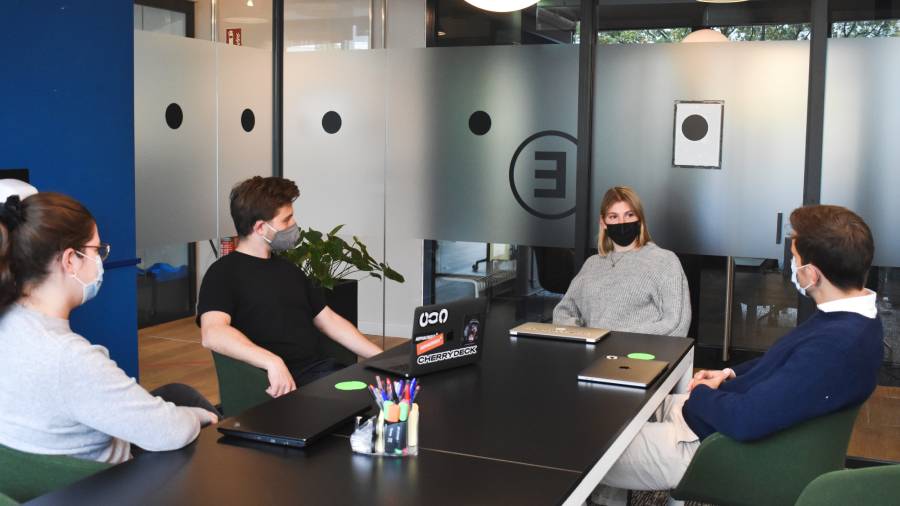
According to research carried out by Aviva, employees generally have a feeling of optimism about returning to the workplace although there are still some areas of concern which persist.
A new survey by Aviva has shown that workers are feeling more optimistic about the return to work following the vaccine roll-out and widespread COVID testing.
This contrasts against data from the lockdown in November where workers exhibited more apprehension about the return to work.
Currently, almost three-quarters of workers (71 per cent) said that the roll-out of the COVID-19 vaccine made them optimistic about returning to work, compared to only half of respondents who stated this in November.

Furthermore, two-thirds of employees (64 per cent) felt that the vaccine roll-out would make them feel safer at work.
In addition to this, another important factor to the respondents was the regular testing of workers for COVID-19.
Three-quarters (75 per cent) said they would be comfortable undertaking testing whilst under one in 10 (7 per cent) stated they would feel uncomfortable with this requirement.
However, despite employee assuredness about health and safety in the workplace, a key area where employers may need to focus their resources is in learning and development post-pandemic.
Almost a quarter (23 per cent) said their job had changed as a result of new business operations due to COVID, but that they were not offered any training on their new role.
In addition, three-fifths (60 per cent) of employees surveyed who had been off during previous lockdowns said that their employer had not offered them refresher training to ensure they are able to continue to do their job safely.
Safety during homeworking was another area which some employers overlooked. Four in 10 employees working from home (40 per cent) stated their employer had not taken steps to ensure their homeworking set-up prevented strain or injury.
As such, the report reiterates that employers should ask employees to complete a homeworking assessment and, if this is likely to be a sustained work-model for the employee, then more rigorous assessments might be required.
Chris Andrews, Director of Aviva Risk Management Solutions, said:
The vaccine rollout has had an enormous benefit to employee confidence in returning safely to the workplace. Our research found that 80 per cent of employees who have been working or furloughed feel confident their workplace is safe and that their employer has standards that they meet to keep employees and the public safe. This is a significant, positive step in our journey back to working normally.
There are, however, a number of risks that businesses must address to ensure that the return to the workplace is wholly successful. Training for employees who have been off work for some time is essential to reduce the chance of injury upon return. Likewise, those employees whose jobs have changed as their business has adapted to Covid restrictions should also receive training on their new ways of working. And if working from home becomes the norm, employers need to do more work to ensure their employees are safe at home and have the appropriate tools and environment to work effectively.
*Aviva’s full findings are documented in their third ‘Employee Back to Work Index’. All data is taken from a survey of 2,021 full-time or part-time employed adults (aged 16+) across the UK, in a wide variety of industry sectors, conducted by Censuswide Research from 30 March – 1 April, 2021 on behalf of Aviva.

Monica Sharma is an English Literature graduate from the University of Warwick. As Editor for HRreview, her particular interests in HR include issues concerning diversity, employment law and wellbeing in the workplace. Alongside this, she has written for student publications in both England and Canada. Monica has also presented her academic work concerning the relationship between legal systems, sexual harassment and racism at a university conference at the University of Western Ontario, Canada.
- Monica Sharma

- Monica Sharma
- Monica Sharma
- Monica Sharma