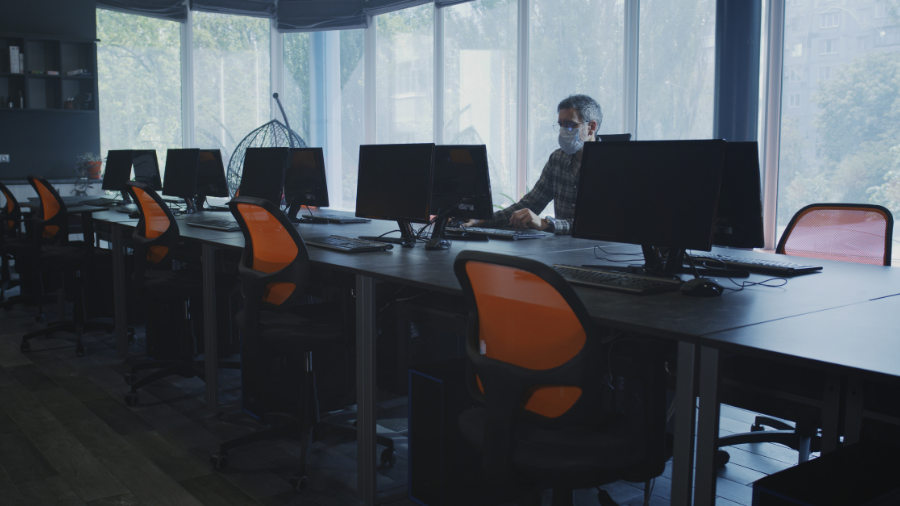
As more organisations provide employees with the option to work remotely, experts say it is important that the office does not become redundant.
A Global Culture Report by OC Tanner found that the office remains vital for nurturing friendships, and supporting a diverse and inclusive workforce.
63 per cent of U.K. workers admit that it is more challenging to form new friendships with colleagues when working remotely, and nearly 60 per cent said that the office is where most of their new friendships are formed.
MD at OC Tanner, Robert Ordever said: “These relationships and interactions enhance the employee experience, deepening ties between peers, leaders and organisational purpose, while ensuring a more inclusive culture.”

The findings come after a survey of 38,000 employees and leaders globally.
Office interactions help people from different backgrounds become friends
Seventy one percent of U.K. workers admit it is easier to make personal connections with other generations, when in the office.
The same number said that they are more likely to make friendships with people of different backgrounds and beliefs, when working in an office environment.
Ordever said: ”The office is key for creating and nurturing personal connections, and enabling employees to more easily form relationships with people of different backgrounds.”
The study found that social connectivity in the office also led to an overall increase in engagement.
Unplanned office encounters valued by employees
Remote working requires interactions to be purposeful and planned, leaving very little to chance.
Seventy one per cent of U.K. workers said that they value random interactions with colleagues at the office.
O.C. Tanner warns that a lack of spontaneous encounters in full-time remote working can be detrimental to both the employee experience, and the organisation as a whole.
Ordever adds, “ Leaders must recognise the value of the office, and ensure that full-time remote working doesn’t become the norm.”
Burnout classified as a “workplace phenomenon’
Spending too much time at work is also raising concerns.
A nationwide survey into work life balance has found that office workers are putting in overtime hours every single day.
Those working longer are also the ones that are most likely to experience burnout.
Described as ‘a state of physical and mental exhaustion which can occur when one experiences chronic workplace stress’, burnout was recently classified as a ‘workplace phenomenon’ by the World Health Organization.
Work-life balance needs urgent improvement across UK businesses, as over a third of workers are skipping more lunch breaks now than this time last year, while 1 in 5 check platforms like Slack every hour – even when they’re on annual leave.
Rosie Hyam, People Partner at Just Eat for Business believes: “Regardless of how teams are working – whether it’s in the office, at home, or a hybrid solution – it’s essential to take regular breaks. Without these, it’s not surprising that so many workers are feeling more burnt out than before.

Feyaza Khan has been a journalist for more than 20 years in print and broadcast. Her special interests include neurodiversity in the workplace, tech, diversity, trauma and wellbeing.
- Feyaza Khan

- Feyaza Khan
- Feyaza Khan
- Feyaza Khan