

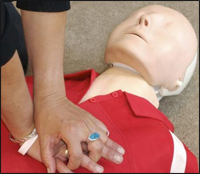
 As this week (11th-15th April) is National Health Awareness week, St John Ambulance has revealed that one in five employees know someone who has suffered a cardiac arrest at their workplace. Around 30,000 people experience a cardiac arrest outside a hospital environment each year, yet only one-third received CPR from a bystander. In this situation, every minute without defibrillation equates to a 7-10% reduction in the chance of a positive outcome. Almost two-thirds of employees feel that businesses should provide this life saving equipment.
Automated external defibrillators (AEDs), which shock the heart back into rhythm, can increase chances of survival up to 75%. These are available to businesses and two-thirds (67%)* of employees believe that if their workplace knew that AEDs were simple to use and that anyone can lawfully use one without training, they would be far more likely to get one.
Richard Evens, Commercial Training Director at St John Ambulance, says: ‘Every year, thousands of people die of cardiac arrest when first aid could give them the chance to live. Our research shows that currently 72% of businesses don’t have access to an AED, despite 66% of employees believing that employers should reasonably be expected to keep one.’*.
St John Ambulance strongly recommends employees attend training on the use of AEDs so that their first experience with the machine is not in a life and death situation and 95%* of employees agree that training would make them feel more comfortable using an AED on a cardiac arrest victim.

’The latest guidance on CPR states that anyone can use an AED without training. The machines are now so simple to use that access is the most important thing. It means that anyone, trained or untrained, can be the difference between a life lost and a life saved in an emergency,’ continued Evens.




