
 In this article, Geoff Moore, Professor of Business Ethics at Durham Business School suggests a more philosophical take on Corporate Social Responsibility (CSR) and focuses instead on what he describes as `organisational virtue.`
I want to suggest that there are two dimensions along which we can make a judgement about organisational virtue and that we can make some sort of assessment of where any organisation is on those two dimensions, quite possibly doing that over time so that we then have a map. And I want to suggest that we can then see not only where we would like the organisation to move to if it is to become ‘better’ (which does not necessarily mean more successful in conventional terms), but also how it might get there.
I will illustrate this with a practical and real-life example based on some of my research, although I will keep the organisation itself hidden to preserve confidentiality. But you have my word that there is such an organisation and that the results I provide derive from the research I did within it, mostly through a series of interviews with managers at many different levels and in a variety of functions.
Two dimensions for organisational virtue

The first dimension for organisational virtue is to do with the purpose of the organisation. Why are we here? What difference do our goods or services really make in contributing to a society that is a better place to live and in which the natural environment on which we all depend is not compromised? I am not aware that these kinds of discussion take place with any regularity (or at all?) within corporate boardrooms. Nor does the conventional approach to CSR put such issues on the agenda because CSR has become increasingly a strategic matter – aligning the CSR strategy with corporate strategy and seeing that CSR makes its contribution to the bottom line.
This is because conventional corporate governance and the kind of CSR that goes with it – shareholder-oriented corporate governance – assumes that this kind of debate is already decided. The ends of business are already given and it’s all about shareholder value. But the way of thinking about business that I am advocating raises questions on precisely this point. It suggests that the ends, or purpose, are never about shareholder value or, more generally, success, but are always about the contribution a business makes to society. Success is absent, but it enters the picture in the second dimension.
So the two questions that ought to be going on inside a business (and on which we could form some kind of judgment even if not easily a quantitative one) are these: to what extent do the goods and / or services that the business produces contribute to the overriding good of the community, and to what extent is there a continuing debate within the business as to what the community’s good is and how the business contributes to it? This is obviously challenging for tobacco companies, armaments manufacturers, those businesses involved in pornography and so on (some of which, of course, do rather well in CSR terms). But even for other businesses – manufacturers, distributors and retailers alike – these are serious and significant questions which ought to demand Board time on a regular basis.
The second dimension is to do with excellence and success. The idea is this. It is possible (and I’ve done it in my research) to ask a business, through its managers, what it means to be an excellent x, y or z type of business. Managers seem to have no difficulty in giving a whole series of terms about the excellence of their products, their customer service, the way they treat their staff, about being socially and environmentally responsible and so on. It is also possible (and, again, I’ve done it in a real-life situation) to ask how the business measures success. This leads to another list, which is likely to be financially oriented but also to have other measures like customer satisfaction which feed in to success. Then I’ve asked the managers to score where the business is now on excellence versus success out of 10 (so 10-0, 5-5, 0-10 would all be possible scores but 7-5 wouldn’t). I’ve also asked them where the organisation has been in the past (to get the time dimension) and what they think the ideal score is.
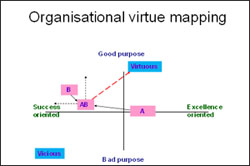
We can then map this on a simple grid, as shown in diagram to the right – and this uses the data from the research I’ve done to map an actual business organisation to illustrate how it works in practice.
A case study: mapping organisational virtue
It seems clear that the virtuous organisation has a good purpose and places the emphasis just on the excellence side of success-excellence. The interviewees on average scored the ideal organisation as focusing on excellence over success by 5.15 to 4.85 – so they recognised the need for some kind of balance but that excellence should be prioritised over success. The vicious organisation (to use the technical term since the opposite of virtue is vice) occupies bottom left – a bad purpose and entirely success oriented.
The business organisation in which I did the research had an interesting history – it had come about as a result of a recent merger of two separate organisations A and B. So in this case I was able to get a sense of the position of the two organisations before they merged. Hence A had the success-excellence balance about right but did not have such a good purpose as B. B was clearly much more success oriented. The merger caused moderation on both dimensions, so AB was less success oriented than B but had a better purpose than A. In terms of where the organisation was going (the merger having happened relatively recently), the interviewees thought it was moving in the right direction as far as purpose was concerned (the dotted arrow pointing vertically up from AB) but also moving in a more success-oriented direction (the horizontal dotted arrow) as the achievement of financial results became more pressing. Combine those two and it can be seen that the organisation was moving away from the virtuous position – at roughly 90o to where it should be going if it wanted to be virtuous. One other interesting finding that emerged from the interviews was a definite sense that excellence was a pre-requisite for success, though didn’t guarantee it. Hence, the interviewees themselves acknowledged that the organisation was not moving in the right direction on both dimensions.
In one sense it is a fairly easy task to map your own organisation onto a grid like this although, as so often, it is the process (and wide engagement in it) that is important as well as the results that emerge. But this should also lead to a discussion about which direction the organisation is headed in, whether that is the desired direction and, if not, what might be done about it. And all of that ought to be a lot more profound than discussions of (strategic) CSR.
So how virtuous is your business?