
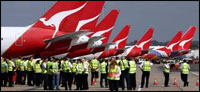
 Qantas has grounded its entire worldwide fleet because of industrial action by its employees – stranding an estimated 13,000 people over the next 24 hours.
Frustrated passengers included 17 world leaders attending a Commonwealth summit in the western city of Perth. William Hague, the Foreign Secretary, was understood to be among them.
The Australian prime minister, Julia Gillard, said her government would help the Commonwealth leaders fly home. “They took it in good spirits when I briefed them about it,” she said.
The Australian government called for an emergency arbitration hearing, which was ajourned early Sunday after hearing evidence from the airline and unions, who are protesting planned job cuts. It will resume on Sunday afternoon when the government will argue that the airline be ordered to fly in Australia’s economic interests.

The strike is estimated to cost the Australian airline A$20m (£13.3m) a day. Among those who may be affected are British passengers heading to Australia on British Airways, which has a joint services agreement with the airline.
“British Airways-operated flights between the UK and Australia are not expected to be disrupted at this time,” said a BA spokesman.
“Customers who are booked to travel on a British Airways service operated by Qantas are urged to check the status of their flight.”
Chris Crulley, 25, from Newcastle, said last night (SAT) that the pilot on his Qantas flight informed passengers while taxiing down a Sydney runway that he had to return to the terminal “to take an important phone call.” The flight was then grounded.
“We’re all set for the flight and settled in and the next thing – I’m stunned. We’re getting back off the plane,” he said. “I’ve got to get back to the other side of the world by Wednesday for work. It’s a nightmare.”
Qantas offered him up to A$350 (£233) a day for food and accommodation, but Mr Crulley expected to struggle to find a hotel at short notice in Sydney.
Ongoing action by three unions representing its long-haul pilots, engineers and baggage handlers has resulted in flights being cancelled and grounded over the last few months.
This prompted a slump in bookings that has cost the company A$68m, with the group now losing A$15m a week in revenue.
“They are trashing our strategy and our brand,” said Alan Joyce, chief executive. “They are deliberately destabilizing the company and there is no end in sight.
“If this action continues as the unions have promised, we will have no choice but to close down Qantas part by part.”
Mr Joyce said that he would not take “the easy way out” and agree to union demands. “That would destroy Qantas in the long term.
“I’m actually taking the bold decision, an unbelievable decision, a very hard decision, to ground this airline,” he said. He added that grounding all the planes was the “fastest way to ensure the airline gets back in the air.”
Qantas has 65 per cent of the Australian domestic market, but its international operation has been making losses. The company is trying to restructure, shedding 1,000 jobs from its workforce of 35,000. The slow international market and industrial action caused Qantas’ share price to slump 46pc over the last year.
“Customers booked on Qantas flights should not go to the airport until further notice,” a company statement said. “A full refund will be available to any customer who chooses to cancel their flight.”
On Saturday night about 1,310 international passengers were thought to be at international airports now waiting for their flights to depart.
Qantas said it “apologises sincerely to all affected passengers”.
The carrier will now “lock out” striking workers from 8pm on Monday “until further notice”. This means the staff will not be required to work and not be paid.